I Married an Angel (Film version) 1942
Music by Richard Rodgers
Produced by Hunt Stomberg for M.G.M
Directed by W.S. Van Dyke II
Starring: Jeanette MacDonald and Nelson Eddy
Screenplay by Anita Loos
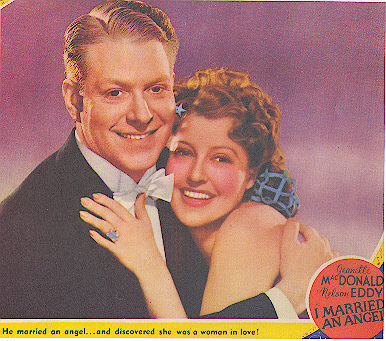 |
Anna Zador (Jeanette) is a shy secretary with a secret crush on her banker boss, Count Willie Palaffi (Nelson). Costume stills show that the character started out quite dowdy, with old-maid clothes and horn rim glasses, but by the time the cameras rolled, Anna had become so ravishing that only blindness or script requirements could keep Willie from noticing her.
Anna's supervisor is Marika (Mona Maris), a vamp who intends to get as much jewelry as possible out of Willie when he isn't busy with other women. Marika even takes credit for the flowers that Anna leaves on the Count's desk each day - a desk he visits for a few minutes each morning on his way home from his nightly revels. (Remnants of the end of a big production number cut from the film, "Little Workaday World," can be seen as Nelson enters the bank.)
A dour, elderly bank official whom Willie calls "Whiskers" (Reginald Owen, in a part created for the film) brings the news that the bank's biggest depositor, the Baron Szigetti, is threatening to remove his account unless Willie stops neglecting business. If the Baron goes, Whiskers warns, there will be a run on the bank. "But," Willie counters, "why should I stop having fun with a great man like you in charge?"
Today is Willie's 35th birthday and a big costume party is planned. All the Palaffi ancestors had married and produced an heir by the time they reached 35, so Whiskers decides that drastic steps are necessary. He insists that, since Marika has received an invitation, then Anna must get one too. "Why Willie doesn't even know her," gasps Marika incredulously. "It might be very good for him if he did," Whiskers declares. Marika purrs malevolently as she delivers the invitation to Anna, pretending it was her own idea, and helps Anna decide on a costume: "You must come as something very good, someone angelic..."
Willie's madcap party rivals the Mardi Gras for lavishness, so Anna's entrance in a homemade costume and lopsided wire halo causes much mirth among the sophisticated guests. Her timid efforts to give him the obligatory birthday kiss is a comic highlight of the film. After dancing briefly with Anna, Willie flees upstairs. There Whiskers strongly urges him to marry a good woman, virtuous and loyal. Willie scoffs at the existence of such a creature. Whiskers can just reach up to heaven and pull one down for him, Willie says sarcastically. Whiskers continues his tirade, but Willie has fallen asleep.
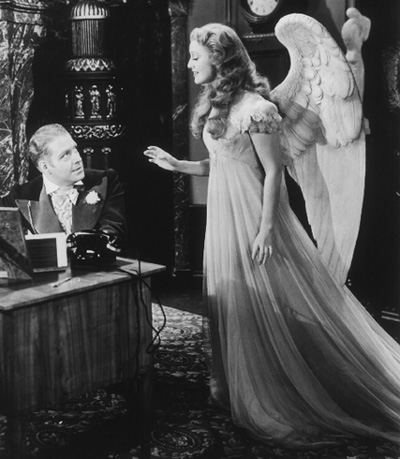 |
The angel Brigitta appears, saying she has come to be his wife and give him children. (Their offspring were excised from the final prints when someone protested they were sacrilegious.) The party guests come to reclaim Willie, but he and Brigitta fly out the window. Their destination is the city of love, Paris.
"I've Married an Angel," Willie sings happily. But on their wedding night, Brigitta chastely bids Willie farewell. She will return to her fluffy cloud for the night and see him in the morning. Willie is understandably disconcerted, but, with a gilded bed prominently in the background, he persuades her to give him a good night kiss. Dissolve to the next morning. Brigitta awakes in that gilded bed with a happy smile but without her wings. Never mind, Willie consoles her, he'll take her shopping.
Brigitta is a big hit with Willie's depositors. There's just one problem. Angels never lie. This creates endless social complications. For one thing, she invites all Willie's girlfriends to live with them. Then, at a party, she tells each guest the truth and seats the men with their "sweethearts" rather than their wives. Even though Brigitta's innocent acceptance of Baron Szigetti's suggestive compliments have made him eager to keep his money in Willie's bank, Willie demands that Brigitta tell nothing but lies from now on. This makes the situation even worse. Willie leaves Brigitta.
Peggy, the wisest and least mercenary of Willie's former girlfriends (Binnie Barnes) , instructs Brigitta in the art of social lying ("A Twinkle in Your Eye"). They conclude the lesson by doing a hot jitterbug.
At a Budapest nightclub, Willie is being consoled by his bevy of beauties when Brigitta sweeps in, wearing a stunning zebra coat, and smoking a cigarette. She is soon joined by Baron Szigetti who obviously has been seeing much of her. Willie becomes jealous and pursues her into an even wilder dream sequence with Faust, pug dogs, power boats, and hula dancing. He wakes up with a crash in his own bedroom and realizes that Brigitta/Anna is the one he should marry. He returns to the party and claims her over a piece of angel cake.
The stars took the brunt of the attack from the ladies and gentlemen of the press, although Variety also blasted the producer and director. The New York Times' comments are perhaps the most typical if not as sarcastic as some: "Mr. Eddy and Miss MacDonald are just not geared to toss a gossamer fable like this one about in the air. Granted they can sing - and they do so in voices loud enough to wake the dead. Their heavy and unesthetic mooning is just too much for the sensibilities to take." MacDonald and Eddy, having reached the status of a national institution, were now considered fair game for the wittiest abuse the media could muster.
 |
Playboy Eddy dreams that he marries an angel (MacDonald) in this bizarre adaptation of Rodgers and Hart musical. This was MacDonald and Eddy's last film together. Songs include "Spring Is Here," title tune.
Leonard Maltin Review: 2.0 stars out of 4
|
Rodgers and Hart's sophisticated musical comedy was purchased for Jeanette MacDonald and Nelson Eddy when their popularity in stale-whipped-cream operetta was waning, but then MGM became nervous, removed the sophistication, and turned the musical comedy into something as bland as operetta but without its energy. This disaster was MacDonald and Eddy's last film together. Directed by W.S. Van Dyke. With Binnie Barnes, Janis Carter, Mona Maris, and Edward Everett Horton.
Pauline Kael
I Married an Angel was the last film Jeanette MacDonald and Nelson Eddy made together. In an interview made during shooting, Nelson was quoted as saying, "This is either going to be the best film we've ever made or the worst."
The score contained two hits that became standards, the title song and "Spring is Here." Rodgers and Hart had originally written it as a follow up to their 1932 Paramount film, Love Me Tonight which starred MacDonald and Chevalier. I Married An Angel was proposed as Miss MacDonald's first film when she moved to MGM in 1933. However, the cyclical rise of Puritanism was just taking effect, and the story of an angel who loses her wings and her virginity simultaneously was considered too risqué.
Rodgers and Hart reclaimed their work and took it to Broadway, where, in 1938, it was a sensation. Since contemporary critics were fond of proclaiming the superiority of the stage Angel over the film, it is important to note that the brightness of the original was based more on style than substance. Once the concept of the angel who becomes charmingly and embarrassingly mortal after her wedding night is established, the story falls into more conventional musical comedy lines with a plot involving getting money for Willie's bank from a wealthy widow.
The film had to make even more changes. On Broadway, the angel appeared after the hero denounced his wayward girlfriend and vowed to marry no one but an angel. His angel was a dancer (Zorina) who didn't sing a note. MGM merged the two parts of Willie's girlfriend, Anna Murphy, and angel-wife, Brigitta into a single singing rôle for Jeanette. The MGM Anna is demoted from girlfriend to secretary, while Willie's sister, Peggy, a major part that starred Vivienne Segal, is transformed into his ex-girlfriend. (That, at least, is an innovation - usually Hollywood turned mistresses into sisters.) Willie's valet, Peter, an important character in the stage version, becomes a glorified walk-on for Edward Everett Horton, probably due to censorship cuts. With Willie's assertive sister gone, a new character is added to the film, that of an older man who berates Willie for his profligacy. Finally, to avoid religious and moral censure, the audience is continually reminded that the angel is part of a dream sequence.
For about twenty minutes, Angel promises to be the most entrancing MacDonald-Eddy film ever made, with style and wit equal to that of the Dorothy Parker/Alan Campbell Sweethearts. Then the censors get out their shears, leaving an incoherent shambles, but one that still yields occasional moments of delight.
Since the success of Naughty Marietta, Jeanette
had insisted that her characters have names beginning with N or
M, a good luck superstition. Therefore, it is intriguing that the
script writers did not retain the stage character's name of "Anna
Murphy." Actually, it would have taken more than luck to save Angel,
for almost no one involved seems to have cared terribly about it.
Scriptwriter Anita Loos didn't have time to be incensed at the revisions
in her script. She was doing three films and a Broadway show simultaneously
and could only remember long coast-to-coast flights. She only recalled
that Jeanette and Nelson stopped speaking to each other when not
in front of the cameras. The film's attempts at screwball comedy
were so undermined that parts of the story are incomprehensible.
Rodgers and Hart were in Hollywood, but generally "unavailable."
(Hart died the following year.) Bob Wright and Chet Forrest were
so incensed at having to do a wholesale rewrite of Hart's classic
lyrics that they quit MGM and went to New York where they achieved
fame with Song of Norway and Kismet..
"Nelson enters the Palaffi Bank (one "l") at the opening of the film, but the birthday party invitation reads Pallaffi (two "l's")." John Cocchi
"In the 35mm print screened at the Lincoln Center Jeanette festival, it is possible to see the tiny thread that guides the bird to Jeanette's finger in the 'Spring is Here' number."
Sheet music:
None
Cds:
I married an angel Broadway version
Discography
The Films Of Jeanette MacDonald and Nelson Eddy