The Merry Widow, 1934 film
Music by Franz Lehár
- Girls, Girls, Girls!
- Vilia
- Melody of the Laughter
- Maxim's
- Merry Widow Waltz
- If Widows are Rich (a.k.a. Widows are Gay)
- It Must Be Love (Dropped before the film was released)
- A Widow Is A Lady (Dropped before the film was released)
- Dolores (Unused)
- Muchacha (Unused)
- Little Dolores (Unused)
Music by Richard Rodgers & Franz Lehár
Produced by Ernest Lubitsch for M.G.M.
Directed by Ernest Lubitsch
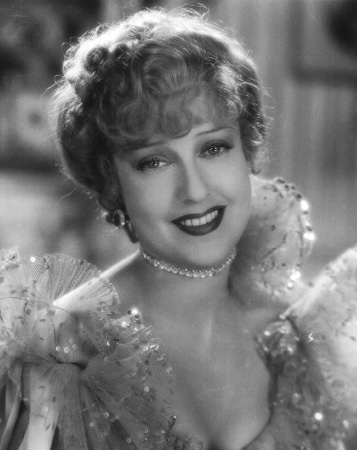
Starring: Maurice Chevalier, Jeanette MacDonald ,Una Merkel and Edward Everett Horton
 |
Marshovia will be bankrupt! King Achmed (George Barbier) returns from an emergency council meeting to find Danilo in the bedroom of the Queen (Una Merkel). Being a pragmatic sort, Achmed offers Danilo a choice: He can persuade the widow to marry him or he can have his ears cut off.
In Paris, Danilo decides to have one last night of freedom before reporting for duty. He sings of the joys of "Maxim's" and his song is overheard by the fun-seeking Widow. She follows him there, and he mistakes her for a Maxim girl, "Fifi." They end up in a private dining room, but she rejects his too-fast advances. He sulks. Then, relenting, she seduces him to the irresistible strains of the "Merry Widow Waltz." However, at the last minute, she realizes that he doesn't really love her, that she is just a "tonight." She flees.
Danilo is scheduled to meet the Widow the next night at an Embassy Ball. Unfortunately, he has realized he loves "Fifi." Failing to find her, he had gotten drunk and blabbed the Marshovian plot to all the Maxim girls who have spread the story all over Paris. He is finally located and retrieved by his valet, Mischka (Sterling Holloway), and taken to the embassy. Again the Widow rejects him, but this time it is she who succumbs to the eroticism of the "Merry Widow Waltz." Their engagement is announced. Then she learns that he has been ordered to marry her. She rejects him again, and he is led off to jail in handcuffs.
There is a trial, Lubitsch's typical "third act" which occurs in all his films and often marks a drop in dramatic interest. Danilo proclaims that "Any man who could dance through life with hundreds of women and chooses to walk with one should be...hanged!" With minimal motivation except plot expediency, the Widow visits him in prison and they are reconciled to lilting strains of the "Merry Widow Waltz."
 |
|
| Censorship Cuts | |
All American TV prints and the currently available commercial video of The Merry Widow have had five major cuts made by television censors in the early 1960's. Missing are:
- In the garden, Danilo boasts that there isn't a window in Marshovia
he hasn't jumped out of, not a husband he hasn't gotten around,
but here he is bluffed.
- Danilo produces his own key to leave the Queen's locked bedroom. (He can still be seen pocketing it as he emerges.)
- Danilo asks a Maxim girl, "Do you still cry when you love someone?"
- A closeup of Lulu's garter and its inscription, "Many Happy Returns"
- Sonia explains that Fifi's method of "committing suicide" was to take a cold bath: "You'd be surprised what a cold bath can do."
The prestige publications rushed to heap glory on The Merry Widow. The New York Times described it as "witty and incandescent...heady as the foam on champagne, fragile as mist, and as delicately gay as a good-natured censor will permit." They said that Chevalier "has never been in better voice or charm," and that Miss MacDonald "is in the twin possession of a captivating personality and lyric voice."
Time Magazine called it "the third and by far the best cinema version of Franz Lehar's famed operetta. Lubitsch [has the] ability to improve a story by telling it as if he didn't mean it."
The trade publication, Variety, assured theatre owners that it was undoubtedly a stick of dynamite for the box office...from now on, if the Lubitsch Merry Widow lead is followed, operetta is in the bag for Hollywood. Maurice Chevalier and Jeanette MacDonald are aces as Danilo and Sonia. The former Paramount pair once again work beautifully in harness together, with this one a cinch to enhance Miss MacDonald's already high rating as a singer and a looker and a good bet to regain much of the ground lost by Chevalier in the last couple of years."
The New York Post said, "It is a Merry Widow Waltz in 6/8 time, brittle and continuously stimulating....it is aided by Miss MacDonald's eminently satisfying voice and Chevalier's delightful acting."
Only one New York paper found fault with the film, but it was a fault that would be echoed in small town papers across the country. The New York World-Telegram reported that, "The Merry Widow, as amended for the talking and singing screen, is no great improvement on the original. Indeed, on the whole it is just a torpid affectation. Lukewarm is the best this cinema thermometer can register for it." Although millions in middle America may not have known what "torpid" meant, they knew what they liked and stayed away from the theatres in large enough numbers to make The Merry Widow a financial albatross for MGM.
|
|
| Overview | |
Franz Lehar was thirty-five years old when his enchanting operetta quickly became an international hit. Unlike so many operettas, the story has a simplicity and timelessness that allows frequent revivals. It is claimed (and highly likely) that there has scarcely been a night since its 1905 premiere without a performance somewhere in the world. The glorious melodies of The Merry Widow have become part of the musical heritage of half the cultures of the world.
Working in the genre of the "little opera" begun by Von Suppè and perfected by Johann Straus Jr., Lehar turned out a musical romance centering on the obligatory waltz theme. However, he didn't present his waltz in the usual big production number. "The Merry Widow Waltz" begins slowly, sensuously, teasingly, as the hero takes the reluctant heroine in his arms and moves her around an empty stage. Only when she responds does the waltz break into dazzling gaiety.
The fantastic popularity of the Widow and the equally fantastic opportunities to make lots of money from her brought about an incredible maze of pirated productions, overlapping rights, and ownership disputes that would keep some lawyers busy for their lifetimes. It also made formulating international copyright laws an absolute necessity.
Lehar, Fritz Stein, and Victor Leon had sold "forever all rights to make motion pictures" of The Merry Widow to Herman Tausky of Paris. he sold this right in 1923 to New York producer Henry Savage (one of Jeanette's early bosses.) Savage in turn sold the rights to MGM who made the extravagant 1925 silent version. They looked forward to making a sound version, but the courts ruled with illuminating ingenuousness that "talkies" were not necessarily "motion pictures."
MGM repurchased the rights in 1929 from Lehar, Stein, Leon B. Hershmensky, and Ludwig Doblinger. But these covered only the stage story and the "Doblinger score" used in Europe. Slightly different scores were being used in England and America. They were warned that if the proposed film used a note of these other two scores, they would be sued. (MGM was understandably nervous: they had already been sued successfully by a real Prince Danilo after the 1925 version, paying him $4,000; They'd also been ordered to pay $250,000 to Prince Youssoupov who claimed he and his wife were defamed in MGM's 1932 film Rasputin and the Empress.) Erich von Stroheim and Benjamin Glazer both claimed the rights to certain aspects of the silent film. All these claims postponed the scheduled 1930 sound version with Sidney Franklin directing.
After Hollywood's non-musical hiatus, The Merry Widow seemed the perfect vehicle to launch MGM's campaign to dominate the musical field. Irving Thalberg had lured the Paramount's musical triumvirate -- Lubitsch, Chevalier, and MacDonald -- to MGM with the irresistible carrot of The Merry Widow.
The Merry Widow is variously reported to have been both "a hit" and "a flop" (American Magazine, September 1937). Both statements are correct. Artistically, the Widow was and is flawless. However, this very level of sophistication made it a money-loser in the hinterlands of the U.S. With Hitler in power, European markets were starting to close to Hollywood products. MGM had always counted on these international markets to turn a profit on its more prestigious and expensive productions. The Merry Widow never returned a profit.
|
|
| Post script | |
Chevalier made only one more American film before returning to France where he continued making film and stage appearances through the World War II. In 1937, an article in American Magazine noted the irony of the respective MacDonald-Chevalier careers. In 1929, Chevalier had been an international star, MacDonald an unknown. Now, eight years later, she was one of the ten top box-office stars of the year, while Chevalier was "through." (Anyone not appearing in a Hollywood film, no matter what their other activities, ceases to exist for American movie goers!) In 1957 he played Audrey Hepburn's father in Billy Wilder's Love in the Afternoon and in 1958 his star status was solidly reclaimed with the musical Gigi. With Jeanette more or less retired, their career positions had reversed yet again.
While studio heads tried to figure out what direction the musical might be taking, Jeanette was rushed into another quickie film, one that would change her life forever: Naughty Marietta.
|
|
| Trivia | |
Intriguingly the widow, who is called "Hannah Glawari" in the stage version, has an entirely different name in the various film versions. Mae Murray was "Sally" in the 1925 silent film. In 1952, Lana Turner was "Crystal." Jeanette is "Madame Sonia" in the 1934 English version, but "Missia Palmieri" in the French version -- possibly a way to explain her accent.
American TV title: The Lady Dances (to avoid confusion with the 1952 Lana Turner version).
Sheet music:
Cds:
None