Hallelujah, I'm A Bum 1933 (film)
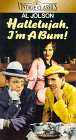 |
- I Gotta Get Back to New York
- My Pal Bumper
- Hallelujah, I'm a Bum
- Laying the Cornerstone
- Sleeping Beauty (Dropped before the film was released)
- Dear June
- Bumper Found a Grand
- What Do You Want With Money?
- Kangaroo Court
- I'd Do It Again
- You Are Too Beautiful
- Hallelujah, I'm a Bum (#2)
Music by Richard Rodgers
Produced by Joseph M. Schenck for U.A.
Directed by Lewis Milestone
Starring: Al Jolson, Madge Evans, Frank Morgan, Harry Langdon, Bert Roach, Tyler Brooke, and Chester Conklin.
Screenplay by S.N. Behrnam
Bumper (Jolson) is the hobo Mayor of Central Park, while his good friend Hastings (Frank Morgan) is Mayor of New York City. Hastings is in love with June Marcher (Madge Evans), whom he has caught with another man. A misunderstanding leads to their breakup and a suicidal June jumps off a bridge. Bumper rescues her, but she now has amnesia. Despite his avowed faithfulness to the bum lifestyle, Bumper falls in love to the point of getting a job for his angel. But can he make a girl from the other side of the tracks happy?
Jolson's gap-toothed smile and infectious laugh carry the day here; even the crankiest soul can hardly help enjoying himself in this whimsical production. The songs, by Rodgers and Hart, are clever and tuneful, most notably the title song. It's certainly odd to see Frank Morgan as something other than the Wizard of Oz—and even odder to see him here saying the line that would wrap up that classic film six years later: "There's no place like home."
Also notable is silent comic Harry Langdon as the communist garbage collector who is Bumper's comic foil. Indeed, most of the bum characters are brought off well, assuredly making the audiences at the height of the Great Depression feel a bit better about their own lots. The one weak link is Madge Evans, who doesn't bring much to the role of June, although she's suitably endearing in her amnesiac state.
Lewis Milestone (All Quiet on the Western Front, among other classics) provides sparkling direction and brisk pacing here. Particularly commendable is a montage sequence depicting the greed that overcomes the bums as they learn that Bumper has found a thousand-dollar bill (an astonishing amount of money in 1933). Rapid cutting and dutch angles in this short sequence remind one of Eisenstein, which is certainly an odd juxtaposition in a sentimental work like this one.
Weirdly, the stuntperson who handles the jump off the bridge for Madge Evans can be plainly seen swimming away after the jump, even though the film cuts to Evans unconscious in the water! Apparently made just before the entrance of the Production Code, there's some mild innuendo, silhouetted nudity and implied swearing, but nothing too objectionable for modern audiences is present here.
Extras Review: The only notable extra is a theatrical
trailer. However, considering how precious few original trailers
survive from the early 1930s, this is definitely welcome. It's interesting
to see that they were still hitting Jolson's epochal appearance
in The Jazz Singer as a selling point for the picture, as well as
the notion that Hallelujah, I'm a Bum! is allegedly the first movie
presented in rhythmic dialogue. English, French and Spanish subtitles
are provided, and the English subtitles are particularly welcome
on a disc like this, where the sound quality is sometimes marginal.
Thank you, MGM, for reinstituting English subtitles!
Image Transfer Review: The source print is in fairly good condition; although there are speckles and occasional scratches, it looks quite good overall, with decent detail. Certainly in contrast to the trailer, it looks fabulous. However, there are problems with the transfer. Whenever the camera moves, or the action moves, there is severe combing visible to the point of being quite irritating. This may not be so noticeable on small televisions, but it was a definite problem on larger equipment. One can hardly get too worked up about MGM's presentation, since one would hardly expect this picture to be high on their list, but just a little more care would have made this a disc I could recommend quite highly.
Audio Transfer Review: The sound, as is par for the course in early 1930s' films, tends to be a shade crackly and noisy. The music tends to be lacking in bass, and Jolson's voice is occasionally shrill. In a few spots, the volume becomes quite low and almost sounds as if it's patched in from another source altogether. But I'd expect this is as good as it's likely to sound without a major restoration. It's certainly acceptable for what it is.
Al Jolson says, "You ain't seen nothin' yet," but this isn't The Jazz Singer. Jolson found one of his better movie roles in Hallelujah, I'm a Bum!, a curious 1933 artifact of the early-sound, pre-Code era, a movie replete with music, political comment, and occasionally risquŽ humor. Jolie plays "the mayor of Central Park," a happy hobo who cleans up after he meets an amnesiac beauty. Alas, the workaday world isn't what it's cracked up to be, as his leisure-minded pals knew all along. Although never quite clicking into classic status, the movie is borne aloft on the Rodgers and Hart score (which includes "You Are Too Beautiful" and much rhyming dialogue) and director Lewis Milestone's fluid tracking shots of hoboes marching and singing through Central Park. That's Harry Langdon, former silent clown, as the Communist tramp warning about the impending revolution as he picks up garbage--a measure of this film's true oddness.
The legendary Al Jolson is the self-proclaimed "Mayor of Central Park" in this "stylized, sophisticated and lyrical" (Pauline Kael) comic operetta--one of the most decidedly different and delightful musicals ever made! A unique attempt to expand the boundaries of the format, Hallelujah, I'm a Bum! captures Jolson at his charismatic best and "reveals more than any of his other surviving films just why [he] was so great a star" (The London Times)! Bumper (Jolson) is the happiest hobo in New York. He's just fallen head-over-heels in love with the beautiful young amnesiac (Madge Evans) he's rescued from a park lake. But when he discovers her true identity, the "Mayor of Central Park" suddenly finds himself competing for her affections with a rich playboy... the Mayor of New York (Frank Morgan, The Wizard of Oz)! Fact from the Vault: Composers Richard Rodgers and Lorenz Hart, whose original score for this film includes the standard "You Are Too Beautiful," both made cameo appearances as photographers in the cornerstone-laying scene.
Maybe that's because its star is Al Jolson, and people just didn't expect him to be in a stylized, sophisticated, lyrical movie. He's very good in it, though; he doesn't wear blackface or get on his knees to sing. Directed by Lewis Milestone, he just takes it easy, and we can enjoy his finesse.
The whimsical script was written by S.N. Behrman and Ben Hecht, and Rodgers and Hart provided a recitative in rhyming couplets.
The film is uneven, but it has some of the
rhythm and charm of the early-30s RenŽ Clair musicals (especially
A NOUS LA LIBERTE), and it has the lovely song You
Are Too Beautiful With Harry Langdon as Jolson's crony,
Egghead; Frank Morgan as the dapper, Jimmy Walker-like Mayor of
New York City; Chester Conklin as Sunday; and the black actor Edgar
Connor as Acorn.
When Bumper and Acorn go to work and get paid, Bumper is delighted
to have the money but Acorn complains that you have to waste so
much time to get it. The clothes show the most elegant side of 30s
fashion; the art direction was by Richard Day.
Pauline Kael
Fascinating Depression curio about a hobo who tries to "reform" for the sake of a beautiful woman. Provocative, politically savvy script by Ben Hecht and S.N. Behrman, rhyming dialogue and lovely songs by Rodgers and Hart (who also make cameo appearances as photographers, following the cornerstone-laying scene), and winning performances all around. Beware edited prints (reissue title: THE HEART OF NEW YORK) and the frequently screened British version, cut and redubbed as HALLELUJAH I'M A TRAMP.
Leonard Maltin Review: 3.5 stars out of
4
Having taken a successful gamble by experimenting with sound in The Jazz Singer ( Warner Bros. 1927), Al Jolson took another chance six years later for United Artists with Hallelujah I'm a Bum (GB: Hallelujah I'm a Tramp) and flopped.
A pity, as it was certainly the best, most adventurous film he had ever made. With its hints of John Gay's The Beggar's Opera, Rene' Clair' s A Nous La Liberte (1931) and Charlie Chaplin's much-loved tramp permeating S.N. Behrman' s rhyming-couplet screenplay from a story by Ben Hecht, what emerged was the only musical in Hollywood's history that was abouttu and dealt directly with the Depression.
Roland Young was originally cast as Hastings, the Mayor of New York, but fell ill after shooting commenced, making it necessary to reshoot his scenes with his replacement, Frank Morgan. This also added to the cost. Finally, two separate versions of the title song were filmed, the word "bum" (unacceptable to British audiences at the time) being changed to "tramp" . Richard Rodgers and Lorenz Hart wrote the score, expanding on the style they'd adopted for Love Me Tonight 1932 and The Phantom President 1932.
In purely musical terms, it was an interesting
experiment for its two songwriters who used rhymed conversation
with musical accompaniment to create what Rodgers has referred to
as "musical dialogue"
Sheet music:
None
Cds:
None